

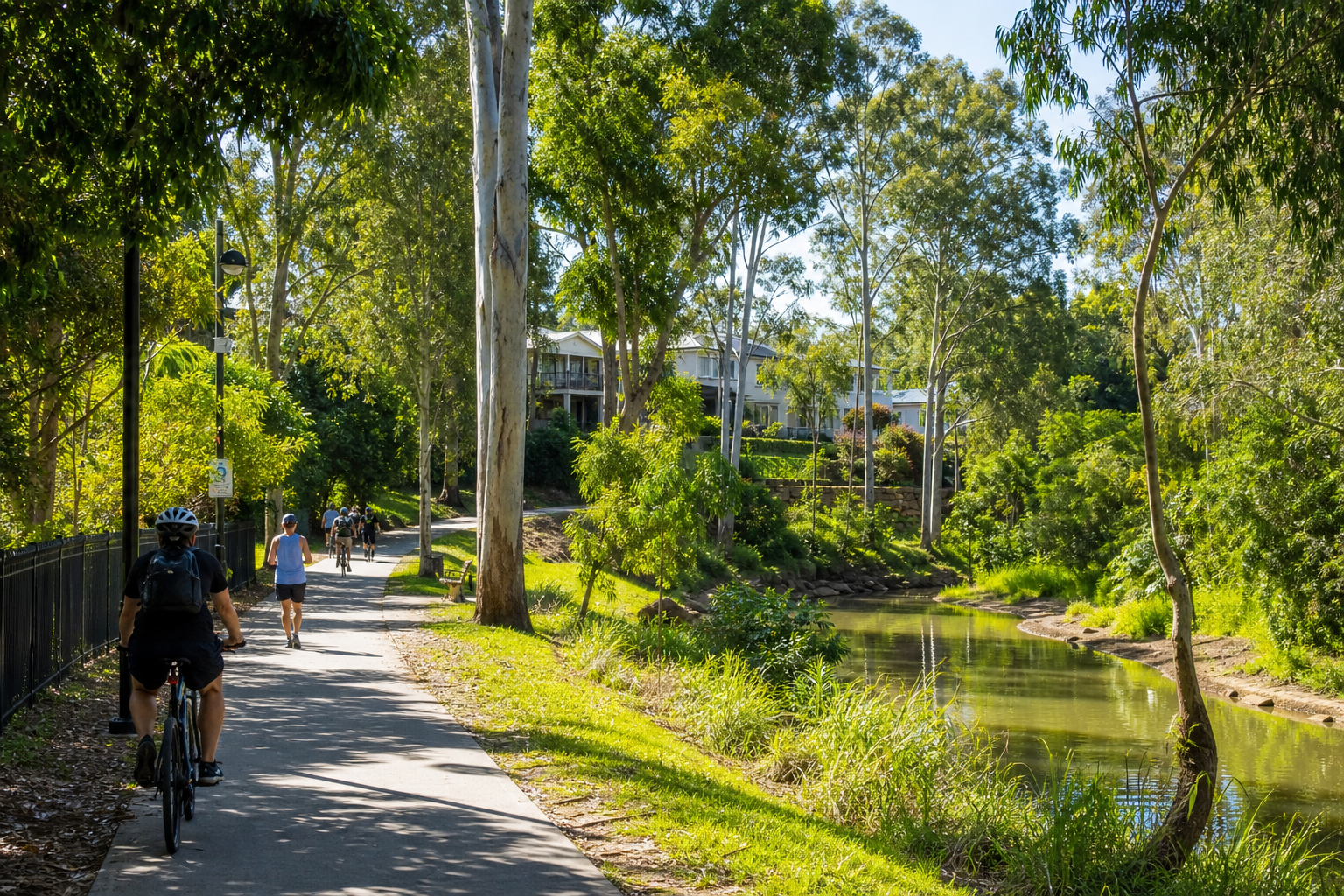
Kedron Brook — named after the Biblical Kidron Valley where Jesus crossed before his arrest. German Moravian missionaries gave it the name when they arrived in 1838, establishing the first free European settlement in what would become Queensland. Today, the brook and its bikeway are the suburb's defining natural amenity.
A Creek Named for a King
It starts with the water. Kedron Brook — the name comes from the Kidron Valley in the Bible, where King David crossed during Absalom's rebellion and where Jesus walked on the night of his betrayal. The German Moravian missionaries who arrived in 1838 to establish the Zion's Hill mission (modern-day Nundah) looked at the creek running through their 650-acre grant and gave it a name freighted with meaning. They were building a new Jerusalem in the southern bush, and this was their sacred stream.
The mission didn't last — it closed in 1846 — but the name stuck. And it's the reason Kedron exists at all: because German Lutherans with a biblical vision chose this waterway as their home.
Judge Lutwyche's Estate (1859–1880)
In 1856, farm lots along Kedron Brook were surveyed. Two of them — near where Gympie Road now runs — were purchased in 1859 by Judge Alfred Lutwyche, a man whose name still appears on maps across Brisbane's north side. He called his estate Kedron Lodge. His land today is the site of Kedron State High School and the emergency services complex — an extraordinary piece of continuity from colonial judge to public education.
The Edinburgh Castle Hotel opened on Gympie Road around 1868, serving travellers on the gold rush route north. Kedron Brook was finally bridged in the 1870s — before that, crossings relied on a ford. The Kedron Park Hotel, built in 1880, was the real catalyst. Its proprietor started horse races, polo matches, and sports days on the hotel grounds, drawing crowds from across the district.
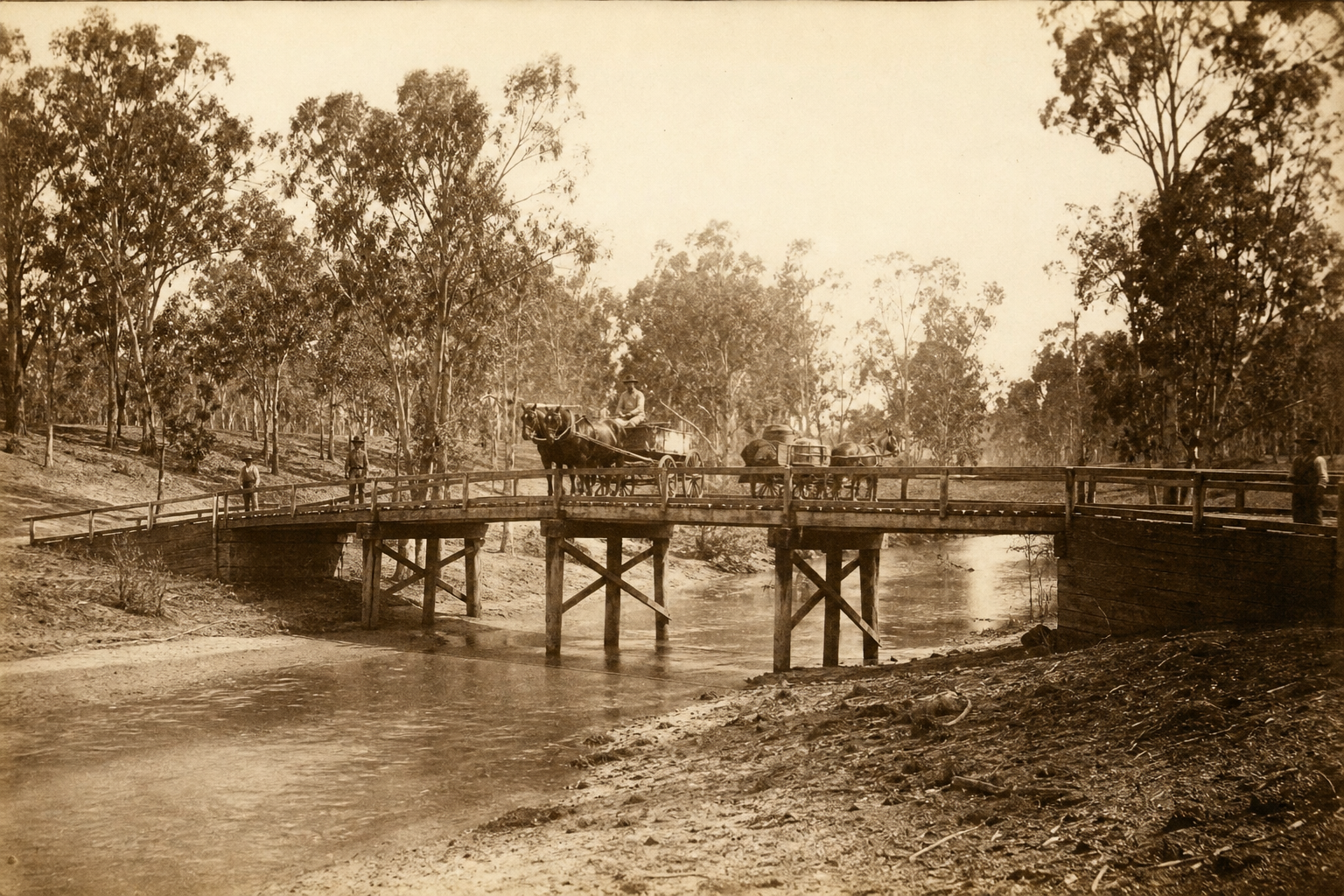
Gympie Road was the main artery north, carrying Cobb & Co coaches and gold rush traffic through what would become Kedron. The Edinburgh Castle Hotel (c.1868) and Kedron Park Hotel (1880) sprang up to serve this traffic, turning a quiet farming district into a destination.
The Gangster Era — John Wren's Pony Track (1911–1931)
This is where Kedron's story takes a turn you don't expect from a school catchment suburb.
In 1911, interests involving John Wren — the notorious Melbourne gambling identity immortalised in Frank Hardy's novel Power Without Glory — acquired Kedron Park as an unregistered pony racing track. Wren built a gambling empire catering to the working class, and Kedron Park was his northern outpost.
But it wasn't just racing. The park became a full-blown entertainment precinct: an outdoor cinema, picnic gardens, a merry-go-round. Families would catch the tram from the city — the Lutwyche Road line had been extended to Kedron Brook in 1913 — and spend the day watching ponies, films, and each other. It was Brisbane's first theme park, hidden inside a suburban paddock.
Wren's name survives in Mercer Park next to Kedron Brook, where an oval commemorates his legacy. The pony racing ended in 1931, a casualty of the Depression and changing laws. Harness racing and dog racing limped on until 1956. When the last race was run, Kedron Park was subdivided into the homes that now form the suburb's central residential fabric.
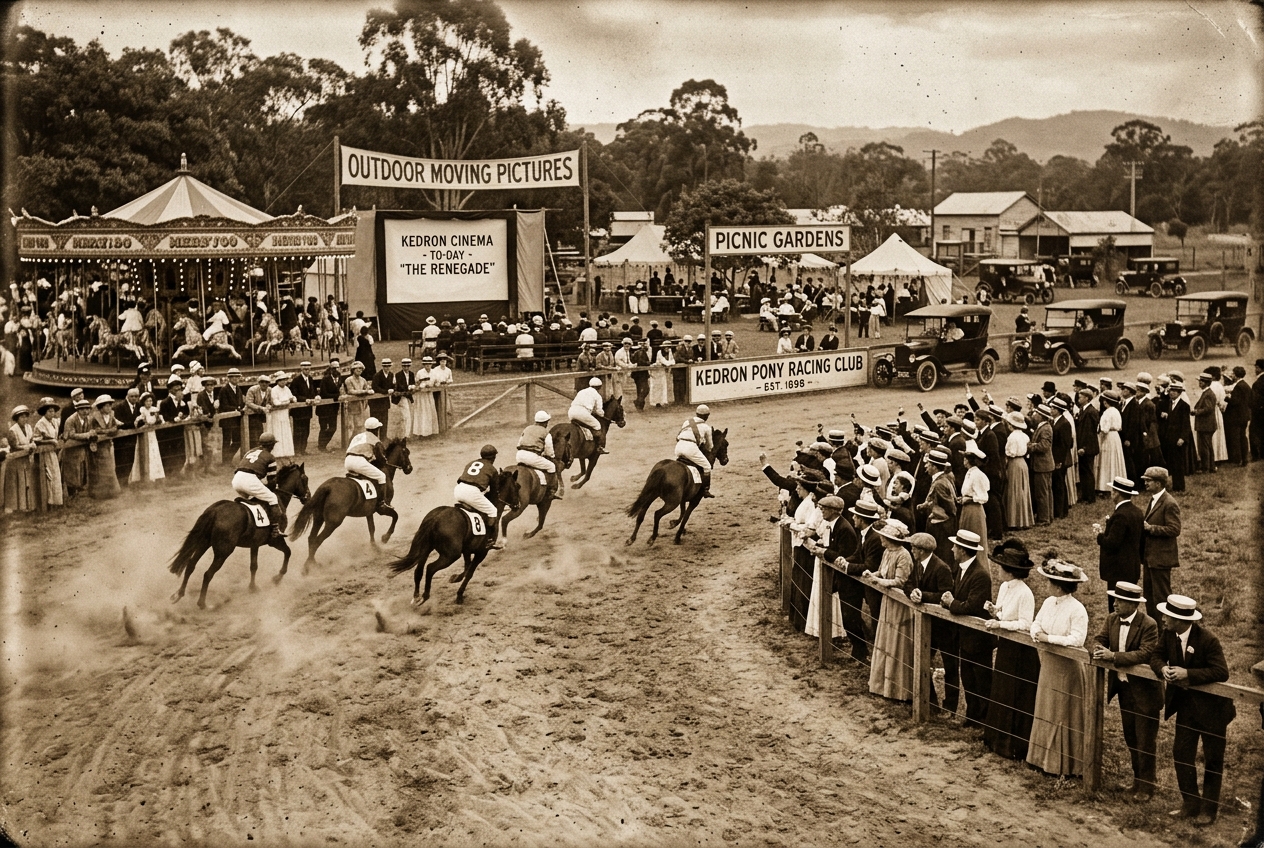
Kedron Park — an illegal pony racing track and entertainment precinct run by associates of notorious Melbourne gambling figure John Wren. Outdoor cinema, merry-go-round, picnic gardens, and gambling for the working class. For two decades, this was Brisbane's most unlikely leisure destination: an underworld operation that was also a perfectly respectable place to take the kids on Saturday afternoon.
The Tramline Suburb (1913–1950s)
The tramline was Kedron's infrastructure catalyst, just as it was for Stafford. When the Lutwyche Road line reached Kedron Brook in 1913, land values shifted overnight. The Kedron Park Tramway Estate (1915) offered 120 "elevated sites" and the Glen Kedron Estate (1917) carved up land east of Leckie Road. When the service was extended to the cemetery in 1925, all of Kedron was suddenly subdividable.
The amenities followed fast: a Methodist church (1925), primary school (1926), School of Arts at Gympie and Broughton Roads (1928), Catholic primary school (1930), and the bowling club (1934–2003). The Catholic Church secured Delamore House in Turner Road — a historic estate that became a convent for the Missionary Sisters of St Francis.
Kedron Shire — the local government area named after the creek — was absorbed into Greater Brisbane in 1925. By then, the district had its own identity, separate from both Nundah to the east and Chermside to the north.
The School That Defines a Suburb (1957–Today)
Kedron's population peaked in the 1950s. The primary school had 1,800 pupils. The Catholic Church opened girls' and boys' secondary schools between 1956–59. And in 1957, Kedron State High School opened its doors — on the very land Judge Lutwyche had called Kedron Lodge a century earlier.
Today, Kedron State High School is one of Brisbane's top-performing public schools. Its catchment zone is arguably the single most valuable asset in the suburb's property market. Families pay a significant premium — often 15–20% above comparable homes outside the zone — for the right to send their children there.
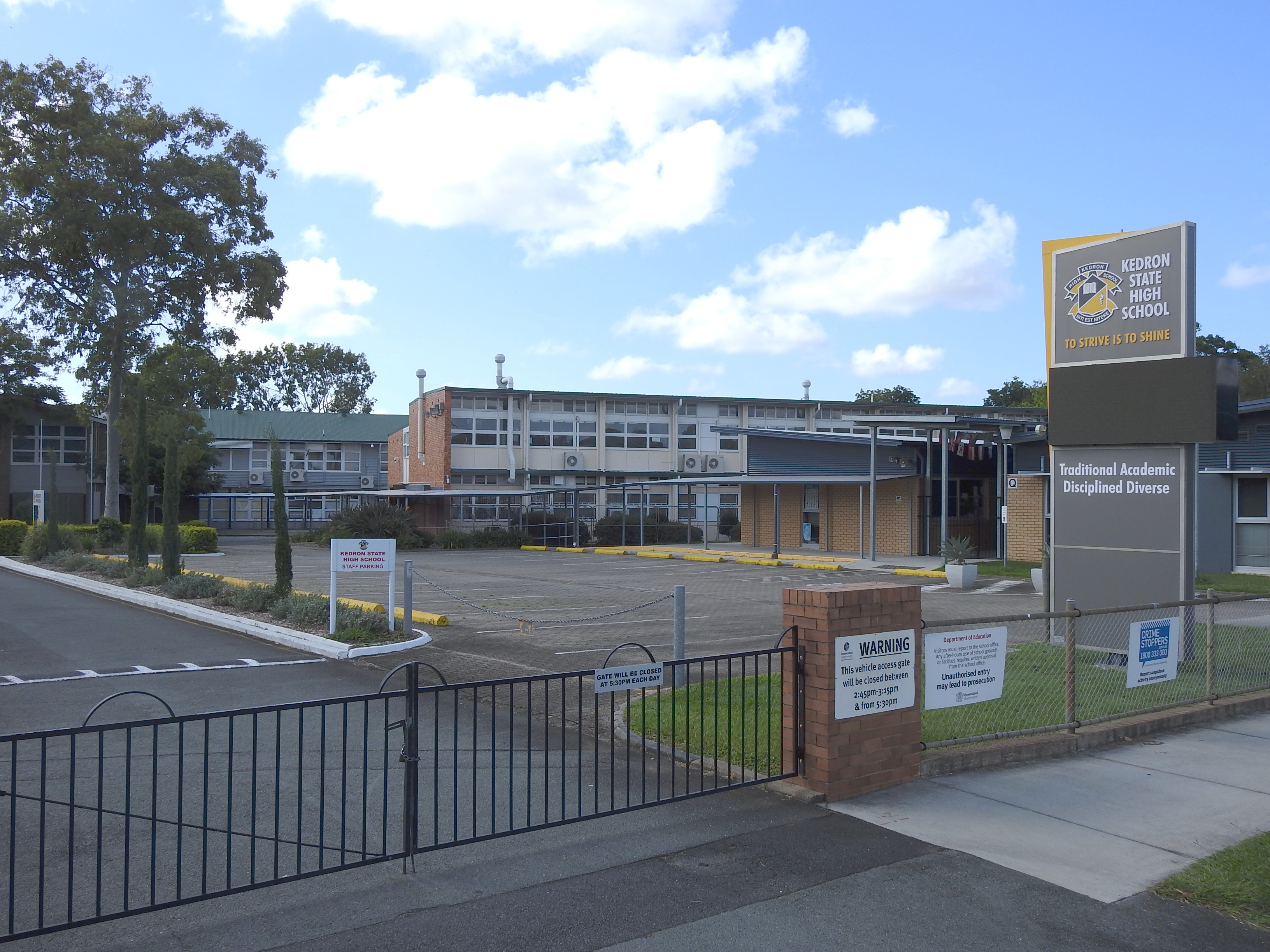
Kedron State High School — one of Brisbane's most sought-after public schools. The school sits on land originally purchased by Judge Alfred Lutwyche in 1859, a continuity of educational purpose that stretches back nearly 170 years. The catchment zone is the defining factor in Kedron's property market.
Kedron Today — The School Catchment Premium
Kedron in 2026 is a suburb of about 8,600 people, eight kilometres from the CBD. Its housing stock is a mixture of interwar and post-war homes — Queenslanders, brick veneers, and a growing number of townhouses and low-rise apartments. Flats now make up about 25% of dwellings, more than double the national average.
The Gympie Road shopping strip serves local needs — bakery, medical centre, pubs, cafes — while Chermside's retail behemoth is literally five minutes north. The Kedron Brook bikeway connects directly to the CBD for cyclists. The Kedron Wavell RSL at the southern end of 7th Brigade Park is undergoing major upgrades, adding new dining and function spaces.
But the real story is the catchment premium. Kedron homes within the high school zone command prices that would be hard to justify on amenity alone. It's the same dynamic that drives up prices in Indooroopilly, Brisbane State High's catchment, and Mansfield — but Kedron's advantage is its compact size. The catchment is small, tightly defined, and fiercely desired.
The Knockdown-Rebuild Wave
Like its neighbour Stafford, Kedron is experiencing a knockdown-rebuild wave. The post-war homes on generous blocks are steadily being replaced — not with housing commission austerity copies, but with premium residences designed for families who could live anywhere but choose Kedron for the school zone.
This dynamic creates interesting tension. The suburb that was once a working-class entertainment district — gangster pony tracks and picnic gardens — is now one of Brisbane's most desirable school-catchment suburbs. The demographic shift from factory workers and public servants to professionals and tradie-entrepreneurs is visible in every renovated kitchen and new-build facade.
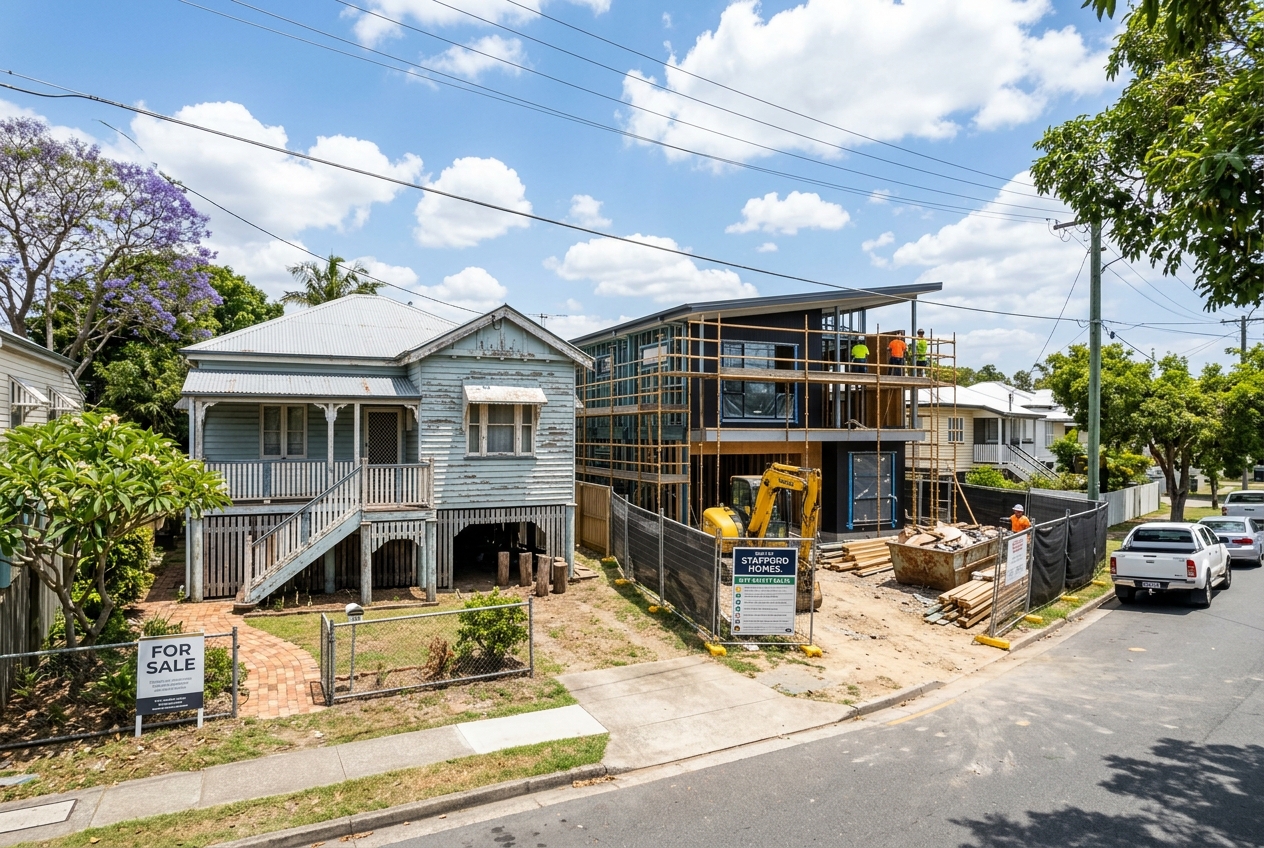
Like its neighbour Stafford, Kedron is seeing a wave of knockdown-rebuild construction as families compete for homes within the high school catchment. The generous blocks that once housed public servants and factory workers are becoming premium residences for a new generation.
What's Next for Kedron?
Kedron's future is written in its school catchment map. As long as Kedron State High School maintains its reputation, demand for homes within the zone will only intensify. The Carseldine Urban Village and Chermside Metro developments to the north will further boost the entire corridor's profile.
The Kedron Wavell RSL precinct upgrades are adding community amenity that benefits the whole suburb. With limited land left to subdivide, and the infill pipeline constrained by the Brisbane City Council's neighbourhood plan, Kedron's character is likely to remain predominantly low-rise — a suburb of Queenslanders and brick homes, slowly upgraded, generation by generation.
Who Should Buy Here?
Kedron is for families who prioritise education above almost everything else. The school catchment premium is real, and it's reinforced every year when Year 12 results are published. If you're planning for children — or your children are approaching high school age — Kedron is one of the smartest bets on Brisbane's north side.
It's also for buyers who appreciate texture and continuity — who'd rather live in a suburb with a bizarre, wonderful history (biblical creek, gangster pony track, judge's estate, school zone) than in a place built yesterday with no memory at all.
Stand on the right street in Kedron and you can see 170 years in a single glance. The creek the missionaries named. The land the judge bought. The school the families chase. And a pony track where gangsters once ran the show.