

🏡 Brisbane North Q3 — median house prices up 4.2% YoY📊 Brisbane dwelling values up 1.8% over the past quarter✨ Free property appraisal — discover your home's value today
Request an appraisal
Suburb Insights/27 May 2026

Living in Margate: Redcliffe's English Seaside Namesake

Margate takes its name from the famous English seaside resort in Kent — a name meaning 'a pool gate or gap in a cliff where pools of water are found,' dating back to 1254. The Redcliffe Peninsula's developers in the 1880s chose a cluster of English resort names — Margate, Scarborough, Clontarf — to evoke the seaside holidays of the mother country. Today, Margate Beach is one of the few genuine surf beaches on Moreton Bay, with a patrolled swimming area, a string of cafes along the esplanade, and holiday homes that recall its century-long role as Brisbane's weekend escape.

Beverley Gibbons
Beverley Gibbons
Brisbane North Real Estate
Margate shares its name with a Kentish seaside town that's been a resort since the 1700s. When the Redcliffe Peninsula's developers were selling land in the 1880s, they deliberately chose English resort names — Margate, Scarborough, Clontarf — to evoke the seaside holidays of home. The strategy worked: Margate Beach became one of Brisbane's most popular weekend destinations, and more than a century later, it's still the go-to spot for a beach day on Moreton Bay.
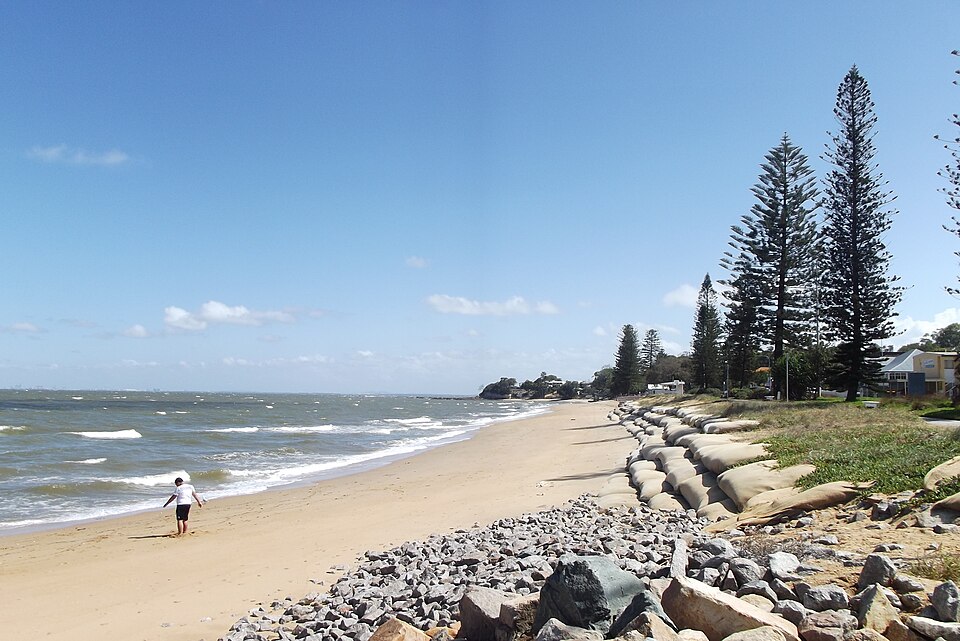
Margate Beach looking south along the esplanade
Present Day

Margate Beach, looking south along the esplanade. One of the few genuine surf beaches on Moreton Bay, Margate has been entertaining Brisbane families since the 1880s. The holiday homes along the foreshore are increasingly being converted to permanent residences as the peninsula grows.

An English Name for a Queensland Beach

The English Margate was recorded as Meregate in 1254, evolving to Margate by 1293. The name translates to 'a pool gate or gap in a cliff where pools of water are found' — an apt description for a seaside town. When Redcliffe Peninsula developers began selling land in the 1880s, they chose the name to evoke the English seaside holidays that potential buyers would have known.

It was part of a deliberate naming cluster: Margate, Scarborough, and Clontarf — all English and Irish coastal resort names — designed to position the Redcliffe Peninsula as Brisbane's answer to the English seaside. The first government land sales in the area occurred in the 1860s, but the suburb's real development came later as the peninsula's population grew.

A Century of Seaside Holidays

For most of the 20th century, Margate was where Brisbanites went for a beach holiday. The Margate Beach stretch — one of the few genuine surf beaches on Moreton Bay — drew families from across the city. Holiday homes lined the esplanade, and the foreshore park became a weekend gathering place. The Margate Baths, a tidal swimming enclosure, gave children a safe place to swim regardless of conditions.

The construction of the Hornibrook Bridge (1935) and later the Houghton Highway made the peninsula more accessible, but Margate retained its holiday charm even as the other peninsula suburbs grew more residential. Today, those original holiday homes are increasingly being converted into permanent residences — a sign that the weekend escape has become a permanent destination.

Margate Today

Margate today is a residential coastal suburb with a strong holiday-at-home feel. The Margate Beach foreshore is the heart of the community — a patrolled swimming area, a playground, picnic shelters, and a string of cafes along the esplanade serving the weekend crowd. The Margate Shopping Village on Oxley Avenue handles daily needs. The Redcliffe Hospital is a few minutes south. The median house price of $820K reflects the suburb's growing popularity as a permanent address rather than just a weekend destination.

Who Should Buy Here?

Margate is for buyers who want a genuine beachside lifestyle at a price that doesn't require a Sunshine Coast budget. It's for families who'll spend summer weekends on the sand, for retirees who want sea views without the high-rise, and for anyone who appreciates that a suburb named after a 13th-century English fishing village can feel like a permanent holiday.

📍 Related suburb guides

margate

More from Suburb Insights

26 May 2026
Living in Albany Creek: From Chinaman's Creek to the Suburb That Never Left
Before it was Albany Creek, it was Chinaman's Creek — a name given by early settlers that stuck for decades, even though no Chinese people ever lived there. When locals finally petitioned for a change in 1885, they picked Albany Creek for 'sentimental reasons.' That sentimental streak has defined the suburb ever since. Seventeen kilometres north of the CBD, Albany Creek is the suburb where the population barely moved in a decade because nobody wants to leave. The story of how it got there — from James Cash's 1849 hut to the South Pine River crossings to the 1960s boom — is the story of Brisbane's northern growth, told in one suburb.
26 May 2026
Living in Bridgeman Downs: The Irish Bank Manager's Acreage That Became a Suburb
Fifteen kilometres north of the CBD, Bridgeman Downs is named after Henry St John Bridgeman, an Irish bank manager who bought a large tract of land here in 1860 but never actually lived on it. Pig farms and pine trees for 120 years — then the late 1980s brought developers, and the paddocks became palaces. Today it has the highest owner-occupier rate in the northern corridor at 68%, 24 parks, the iconic Two Brothers mansions on Beams Road that every local knows, incomes in the top 20% of Queensland, and a median price of $1.18M. The Irishman who never set foot on his own land wouldn't recognise it — but his name is on the map forever.
26 May 2026
Living in Sandgate: Brisbane's Original Seaside Escape
Long before the Gold Coast was a strip of high-rises, before the Sunshine Coast was a weekend destination, there was Sandgate. A pier. A foreshore. A train line that carried Brisbanites to the bay for a day of swimming, fish and chips, and salt air. The Sandgate Town Hall, built in 1913, still stands on Rainbow Street. Bathers at Moora Park — captured in a 1937 State Archives photo — look remarkably like the families who picnic there today. Eighteen kilometres north of the CBD, Sandgate has been doing the same thing for 170 years, and it's never gone out of style.

Thinking about property in Brisbane North?

Beverley would love to chat. Whether you're buying, selling, or just exploring your options — no pressure, just honest advice.

Request an appraisal
Browse all articles →